Great in training. In competition it disappears.
You have trained for years, the technique is solid. But in competition, when it counts and everyone is watching, your performance does not arrive. Your body tightens, your mind takes over, and suddenly the movement that felt natural in training is gone. This is not a lack of talent or toughness. It is your nervous system under pressure. That is exactly where we start.

Ruslan Spartakov · Psychologist (M.Sc.)
How you recognise this
Training goes well, but performance falls apart in competition.
You try to force it, grip harder, do everything right, and that is precisely when it tips.
Physically: racing heart, trembling hands, a hollow stomach, tension that will not release.
Your mind wants to prove you are better than last time, especially in front of familiar opponents or their coaches.
After the competition you know: I can do this in training.
What actually happens in competition
Under pressure and evaluation, your nervous system switches into protection mode. It tries to control the movement more tightly, to steer harder. The paradox is this: that extra control makes the movement less stable, not more precise. A well-rehearsed, automated movement runs best when conscious access leaves it alone. When the mind grips too hard, more noise enters the system and performance tips.
This is my working hypothesis, sharpened in my own practice on my hands. The core insight fits in one sentence: it is not about more control, but about the right amount.
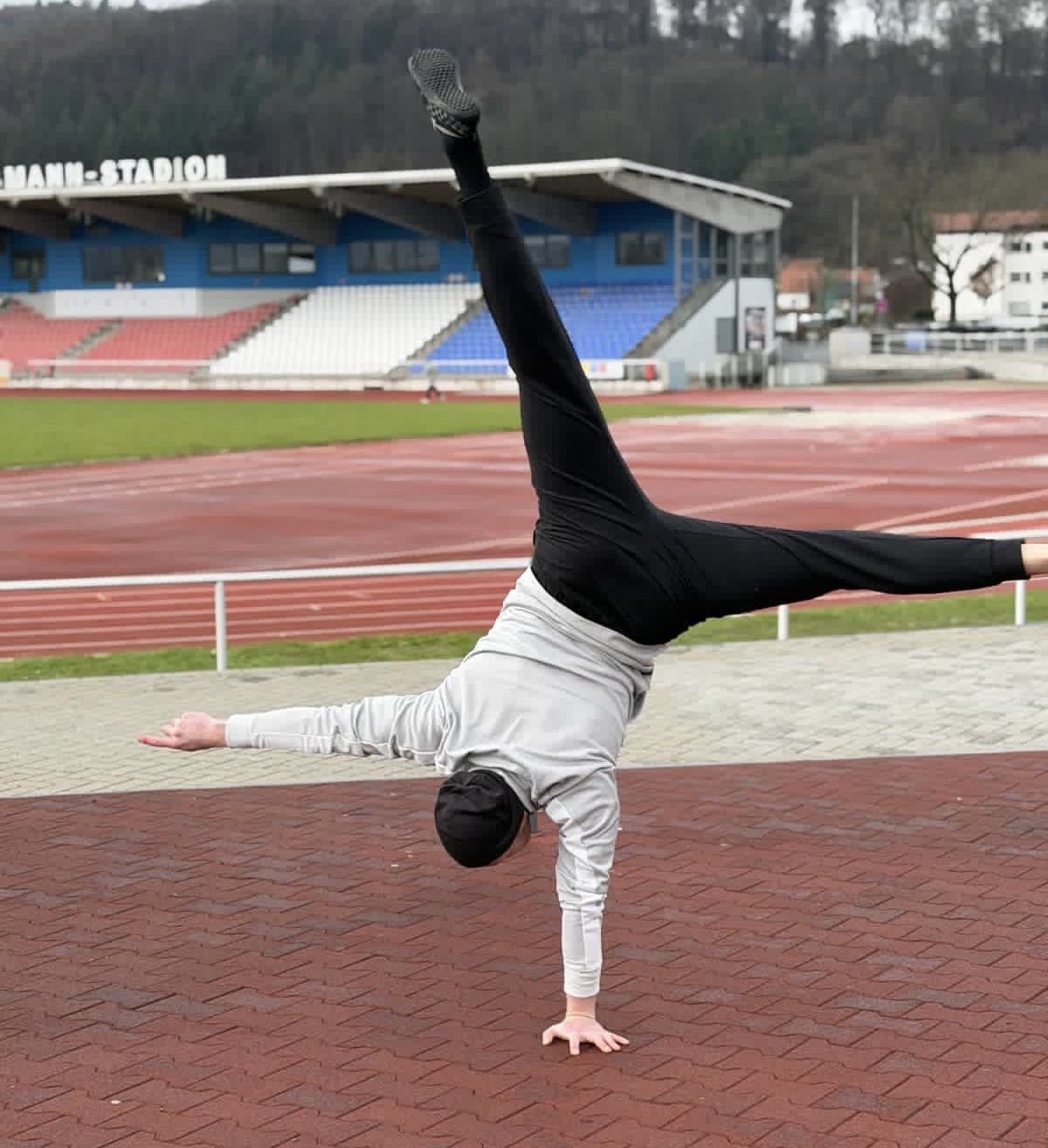
Ruslan Spartakov, one-arm handstand.
In competition, the winner is not the one who controls the most, but the one who can let go at the right moment.
For athletes and for parents
This work fits especially well for fall and balance sports where the fear of falling is part of the equation: figure skating, gymnastics, skiing, climbing, diving, equestrian. The underlying mechanism applies to any sport where you need to deliver under pressure.
Many young athletes come through their parents. That is a good thing. I then work directly with the young person and consciously bring the parents on board, without adding to the pressure that is often part of the problem.
Frequently asked questions
Which sports is this suitable for?
It works especially well for sports where fear, balance and the moment of falling play a role: figure skating, gymnastics, skiing, climbing, diving, equestrian. The underlying mechanism applies wherever you need to perform under pressure.
My child is a teenager. How does that work?
With younger athletes I work directly with them and involve the parents alongside. First I check whether the young person genuinely wants to change something themselves. Without that motivation the work stays at the surface. That is exactly what the free intro call is for.
What makes this different from classic mental training?
Mental training gives you techniques: visualisation, breathing, competition routines. I use those too, where they fit. But I work one level deeper, at what happens in your nervous system when conscious control overrides automated movement under pressure. I see the link to competition as a working hypothesis.
How does a session work?
Online, 50 minutes, over an encrypted video connection. We start with what is most present, often a specific upcoming competition, work with what comes up, and you leave with something concrete to practise in training and competition.
How quickly will I notice a change?
That varies from person to person. You get your first regulation tools early on, so you can practise them in training and competition. Stability under competition pressure takes time and builds through repetition, not through a single aha moment.
The next step
If this sounds like your situation, or your child's, book a free intro call or write to me. We will take the time to clarify whether my support is the right fit.


Member of the BDP · Founder of Metanovia
Psychological counselling and support, not psychotherapy within the meaning of the German Psychotherapeutengesetz and not medical treatment. Not a substitute for medical or psychotherapeutic care. No diagnoses, no promises of healing.